
There’s an assumption in professional services: if you could consolidate everything into one system, you’d eliminate complexity.
One platform. One vendor. One “source of truth.”
It sounds like progress, and for firms under constant pressure, the appeal is obvious.
But in a rapidly changing world, an all‑in‑one approach can create dependencies, especially when it spans multiple different software categories, each with a different rate of innovation.
When one system tries to do everything, it rarely does them all well. Over time, as a firm grows and needs evolve, even small changes can mean confronting a crippling situation of proverbial spinal surgery.
Great firms know that complexity can’t be eliminated, but it can be managed, which is why they focus on architecting an agile tech stack.
Stretching one vendor across multiple software categories can quietly create a single point of dependency. When one system spans categories, a firm's evolution becomes tied to the system's:
Most firms have felt this – the environment shifts, and the tools don't keep up.
Say your firm uses a client portal that’s integrated with its working paper solution or practice management system, and you want to improve how clients upload documents. With a specialized portal, you adjust it – or swap the tool entirely. With an all-in-one, you file a feature request and wait in line behind every other customer, on a roadmap set by a company whose focus and priority may not be your client’s experience.
Different phases of an engagement have different needs. Teams operate differently. Client behavior varies. Timelines compress. Requirements shift.
That’s why dynamic, specialized software matters.
The company building the best solution for executing and documenting compliant engagements isn't necessarily in the best position to solve every problem surrounding the client experience. And the company building the best client experience platform probably won’t be the best at audit automation.
Specialized products tend to do three things better:
This is what “best‑in‑breed” actually means: not more tools, but more capability per tool.
Great firms don’t assemble a messy toolchain. They architect a scalable system that sits at the center of everything and behaves as a single, coherent environment – without procuring everything from one vendor.
That only happens when integration is the infrastructure, not an add‑on.
When systems connect:
For example, in an agile tech stack, firm users, client companies, and client engagements should all be created once, synced across systems and managed centrally.
The result is a connected tech stack that avoids administrative overhead and evolves without disruption. Having the freedom to rip out the old and plug in the new without crippling the team is the strategic win.
Integration is how great firms architect progress without creating dependency.
Most firms evaluating technology ask: “What will simplify the environment?”
A better question is: “What will keep the environment adaptable?”
Because the firms that outperform long‑term will not be the ones with the fewest tools.
They’ll be the ones with the most resilient operating model.
That means prioritizing:
If you want to know whether a firm is building for the future, don’t ask how many tools they use. Ask:
All-in-one systems consolidate. Best-in-breed ecosystems optimize for progress.
The goal isn’t to eliminate complexity by putting everything in one place. It’s about building a technology environment that can evolve without forcing the firm to start over.
Because the best technology decision isn’t the one that works today. It’s the one that gives the firm the freedom to adopt something better tomorrow.
That’s what architecting agility looks like. And in a market that keeps shifting – client expectations, timelines, staffing, regulation – continuous improvement is the only strategy that holds.
.png)
Hundreds of conversations with firm leaders about resourcing, scheduling, and client readiness led us to build Collaborative Scheduling. Great team and client experiences rely on great planning, so we expanded our workflow to help leaders deliver a more consistent experience across all engagements.
Read moreRead more
AI is reshaping how audit teams work. None replaces an auditor's judgment, but they can remove the overhead that stands between auditors and the moments where judgment is applied.
Read moreRead more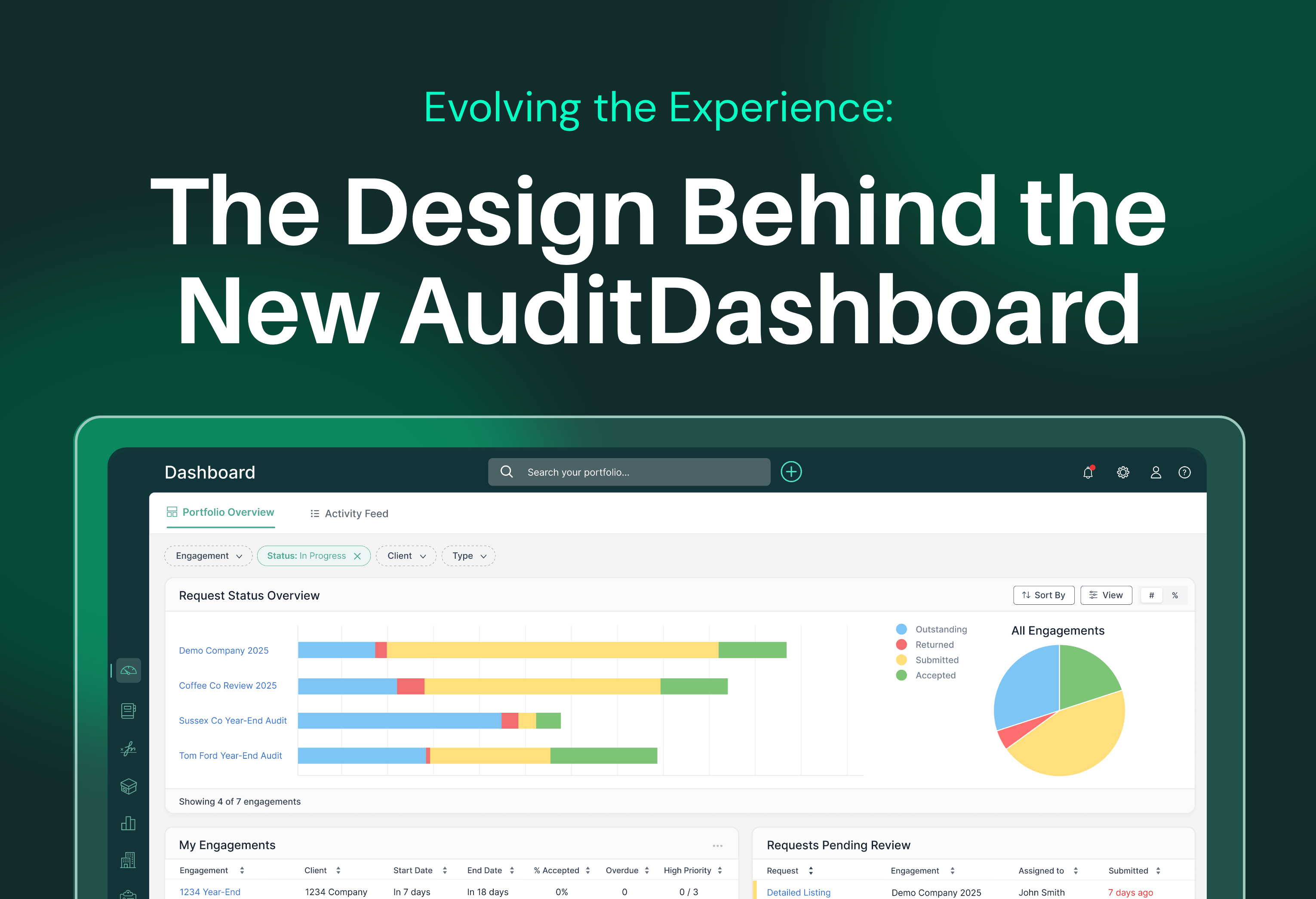
We began reimagining AuditDashboard’s interface with one goal in mind: to modernize the experience while preserving the familiar workflows users depend on every day. Guided by years of meaningful customer conversations, we approached every decision with purpose and care.
Read moreRead more


