

Audit has always been a discipline of details with thousands of documents, hundreds of client interactions, and a standard of evidence that leaves no room for shortcuts. That's exactly why artificial intelligence is proving so useful for auditors. AI doesn't replace professional judgment, but it can remove friction and create capacity to help auditors apply judgment where it matters most.
Here are seven use cases where AI is already reshaping how audit teams work.
Partners and managers juggle multiple engagements at once, and staying on top of where each one stands can mean digging through vague status updates, request trackers, and activity logs. AI can pull all of that together into a clear, current snapshot. Partners and managers can use AuditDashboard’s MCP to answer questions about what's on track, what's overdue, and where bottlenecks are forming — so leadership spends less time hunting for status and more time acting on it.
Vague or ambiguous "Prepared By Client" requests are one of the most common sources of delay in an engagement. Staff can use AuditDashboard’s MCP to review request language before it reaches the client, flagging items that are unclear, too broad, or open to multiple interpretations, and suggesting more precise wording that clients can act on. Clearer requests mean fewer questions, back-and-forth cycles and faster turnaround on evidence.
Memo writing is essential but repetitive: the same structure, the same categories of judgment, applied again and again across accounts and engagements. AI can generate a strong first draft grounded in the underlying workpapers and evidence, freeing auditors to focus on refining conclusions and exercising judgment rather than starting from a blank page.
Reviewing financial statements for consistency, formatting, and completeness of disclosures is detail-intensive work where small errors are easy to miss. AI can flag inconsistencies between statements and supporting schedules, check for missing disclosures, and highlight unusual variances, giving reviewers a head start before their own detailed read-through.
Tests of details are foundational to substantive audit work, but manually tracing samples, recalculating balances, and matching supporting documentation is time-consuming. AI can automate much of this testing by matching invoices, extracting information, recalculating figures, identifying exceptions, and drafting working papers so auditors can focus on the exceptions that actually require judgment.
Contracts often hold the key details that shape an audit's approach — revenue recognition terms, lease obligations, related-party arrangements. Reading through lengthy legal documents to extract those details is slow. AI can quickly summarize multiple contracts, surfacing the clauses most relevant to the audit and pointing reviewers directly to the sections that matter.
Not every supporting document a client provides is the right one, or the correct version, or even fully legible. When Staff use AuditDashboard’s MCP, AI-powered evidence intelligence can scan incoming documents for red flags such as incorrect file types, mismatched documents, missing information, incorrect periods, missing signatures, or file corruption before a reviewer invests time opening them. Catching these issues at intake, rather than during review, saves rework and keeps the engagement moving.
None of these use cases replaces the auditor's judgment. They all remove the overhead that stands between auditors and the moments where judgment is actually applied. As AI capabilities mature, the firms that benefit most will be those that use it not to cut corners but to spend more time on the parts of the audit that require a human mind.
.png)
Hundreds of conversations with firm leaders about resourcing, scheduling, and client readiness led us to build Collaborative Scheduling. Great team and client experiences rely on great planning, so we expanded our workflow to help leaders deliver a more consistent experience across all engagements.
Read moreRead more
All-in-one platforms may simplify your tech stack today, but they can create dependencies that make it harder to evolve tomorrow. This post explores why best-in-breed technology, connected through strong integrations, gives firms the agility to continuously improve, adopt better tools, and build a more resilient tech stack.
Read moreRead more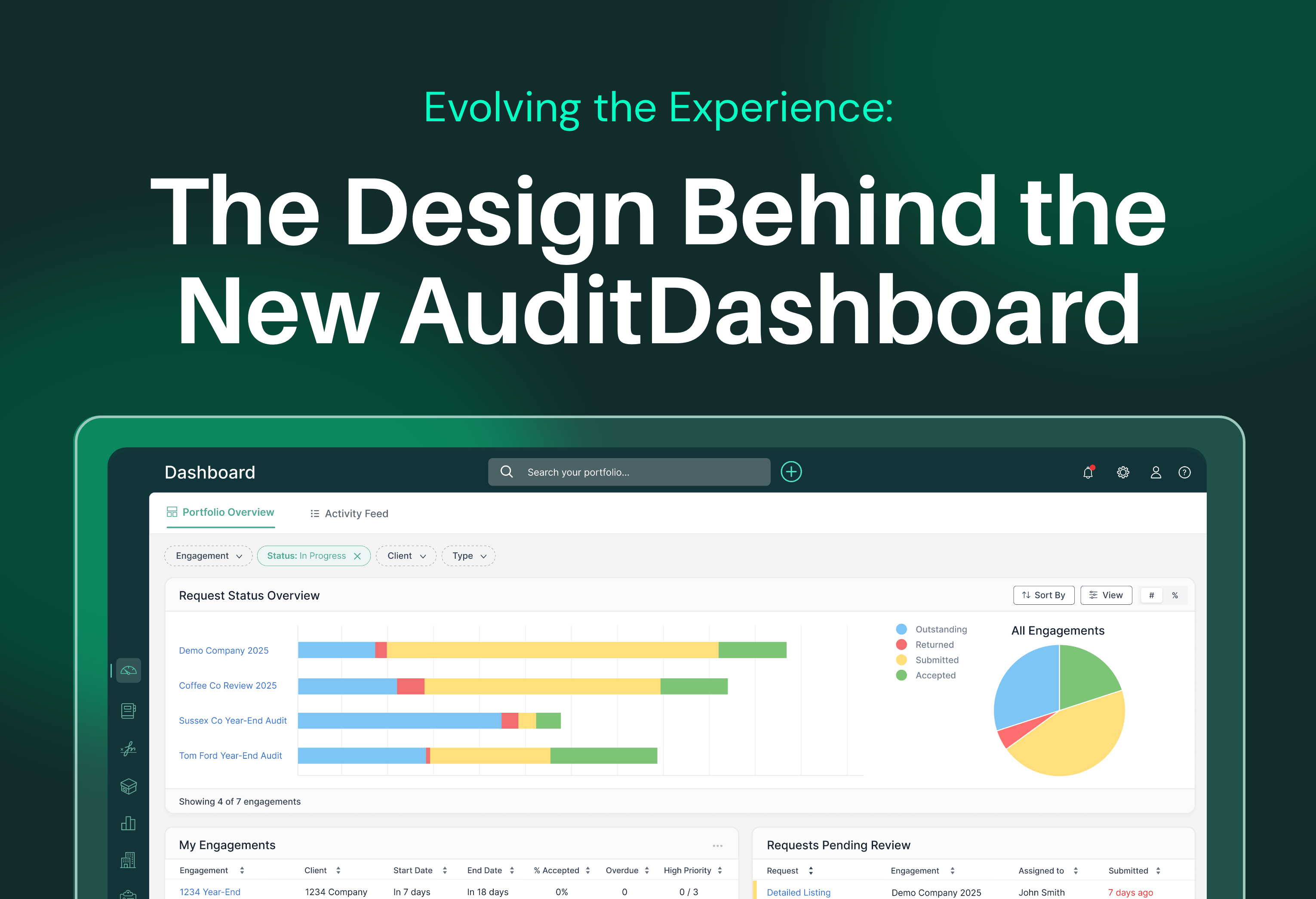
We began reimagining AuditDashboard’s interface with one goal in mind: to modernize the experience while preserving the familiar workflows users depend on every day. Guided by years of meaningful customer conversations, we approached every decision with purpose and care.
Read moreRead more


